I Prepared for Paper Based IELTS, How Do I Switch to Computer-Delivered?
You spent months preparing with printed Cambridge booklets, pencil in hand, timing yourself against a wall clock. Then paper-based IELTS was discontinued, and the test you trained for no longer exists.
Here is the good news: none of your preparation is wasted. Your vocabulary, your grammar, your reading strategies, your essay structures, all of it transfers completely, because the test content is identical. What needs converting is a specific set of physical and procedural habits. This guide gives you a focused three-week plan to make that conversion, based on where paper-trained candidates actually lose marks in the computer format.
First, understand what transfers and what doesn't
Transfers fully (do not re-learn):
All vocabulary and grammar work
Essay structures, planning methods, and model answers for Writing
Question-type strategies (True/False/Not Given, matching headings, multiple choice)
Listening comprehension skills and accent familiarity
Everything about Speaking, the face-to-face interview is completely unchanged
Needs converting (this is your three weeks):
Handwriting speed ??? typing speed
Pencil annotation ??? on-screen highlighter and notes
Listening answer-transfer routine ??? direct on-screen answering
Page-flipping navigation ??? click navigation and review screens
Paper-based time awareness ??? on-screen countdown timer
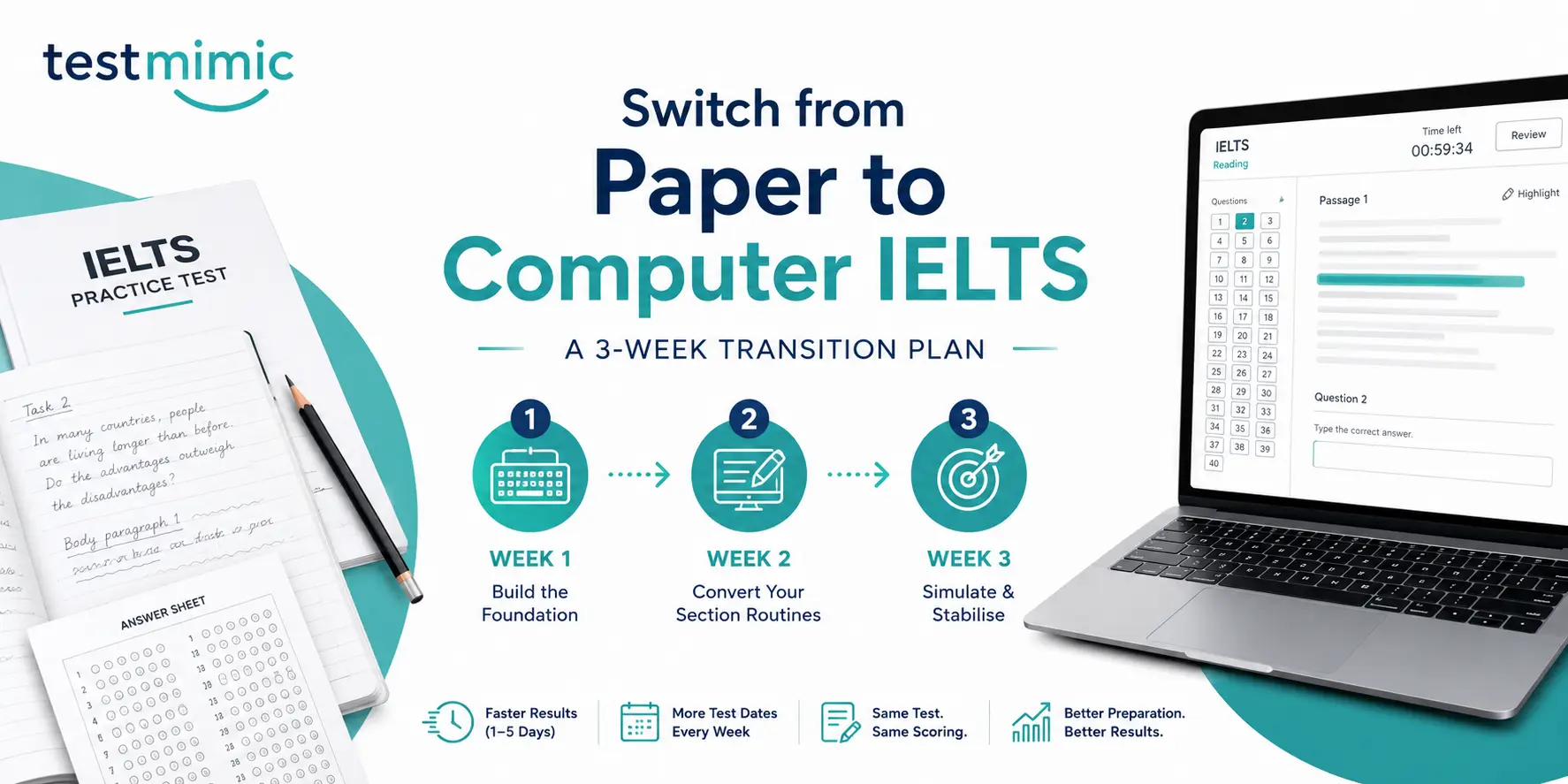
Week 1: Build the mechanical foundation
Days 1???2: Benchmark your typing. Take any free online typing test. If you type below 25 words per minute with reasonable accuracy, this is your single highest-priority fix, Writing Task 2 requires producing 250+ words plus planning and review inside 40 minutes. Fifteen minutes of typing practice a day for three weeks moves most people from uncomfortable to fluent.
Days 3???4: Retype your old essays. Take three Task 2 essays you previously handwrote and type them against a 40-minute timer. This does two things: it converts your existing essay knowledge into the new medium, and it shows you immediately whether typing pace is limiting you. Notice how different editing feels, you can now move a sentence, fix a paragraph order, and correct spelling instantly. Start deliberately using those abilities; they are an advantage paper never gave you.
Days 5???7: Take your first full computer-delivered mock test. Do not wait until you feel "ready", the point of the first mock is to expose every friction point at once, while it is still free to fail. Expect your score to dip slightly below your paper practice scores. That is normal and temporary; it is the format gap you are here to close. TestMimic's free computer-delivered mock test replicates the real interface, so the friction you find is the real friction.
Week 2: Convert your section routines
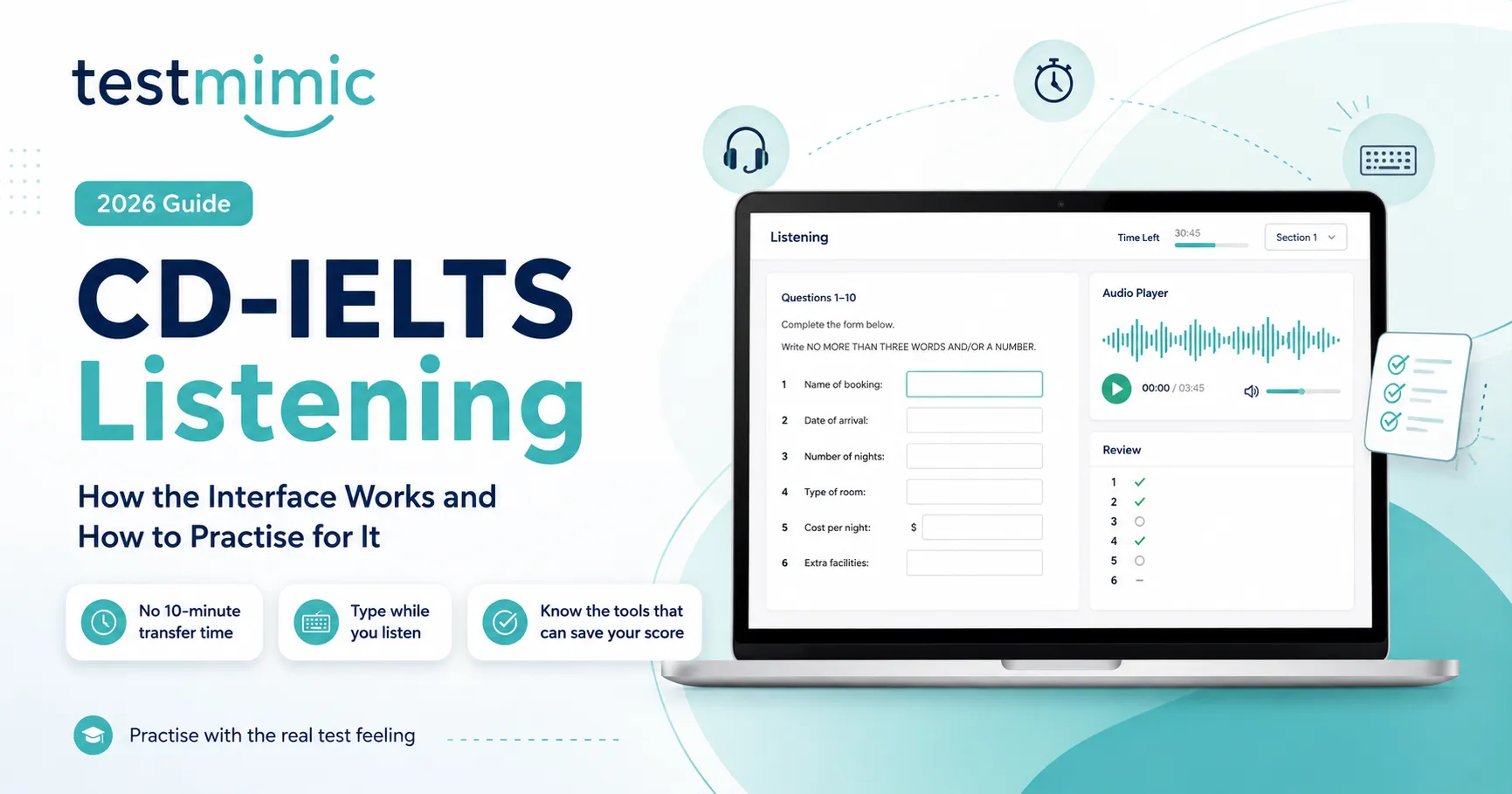
Listening, retire the transfer habit. On paper you had ten minutes at the end to transfer answers, fix spelling, and second-guess. On computer, that window does not exist: you type answers while the audio plays, with only a brief check period at the end. Your new routine:
Type the answer the moment you hear it, do not jot mentally and return later.
Spell it correctly the first time; treat every answer as final.
Use the short review window only to check blanks and obvious typos, not to reconsider.
Practise this with the interface, not just audio files, the skill is the combination of listening and typing.
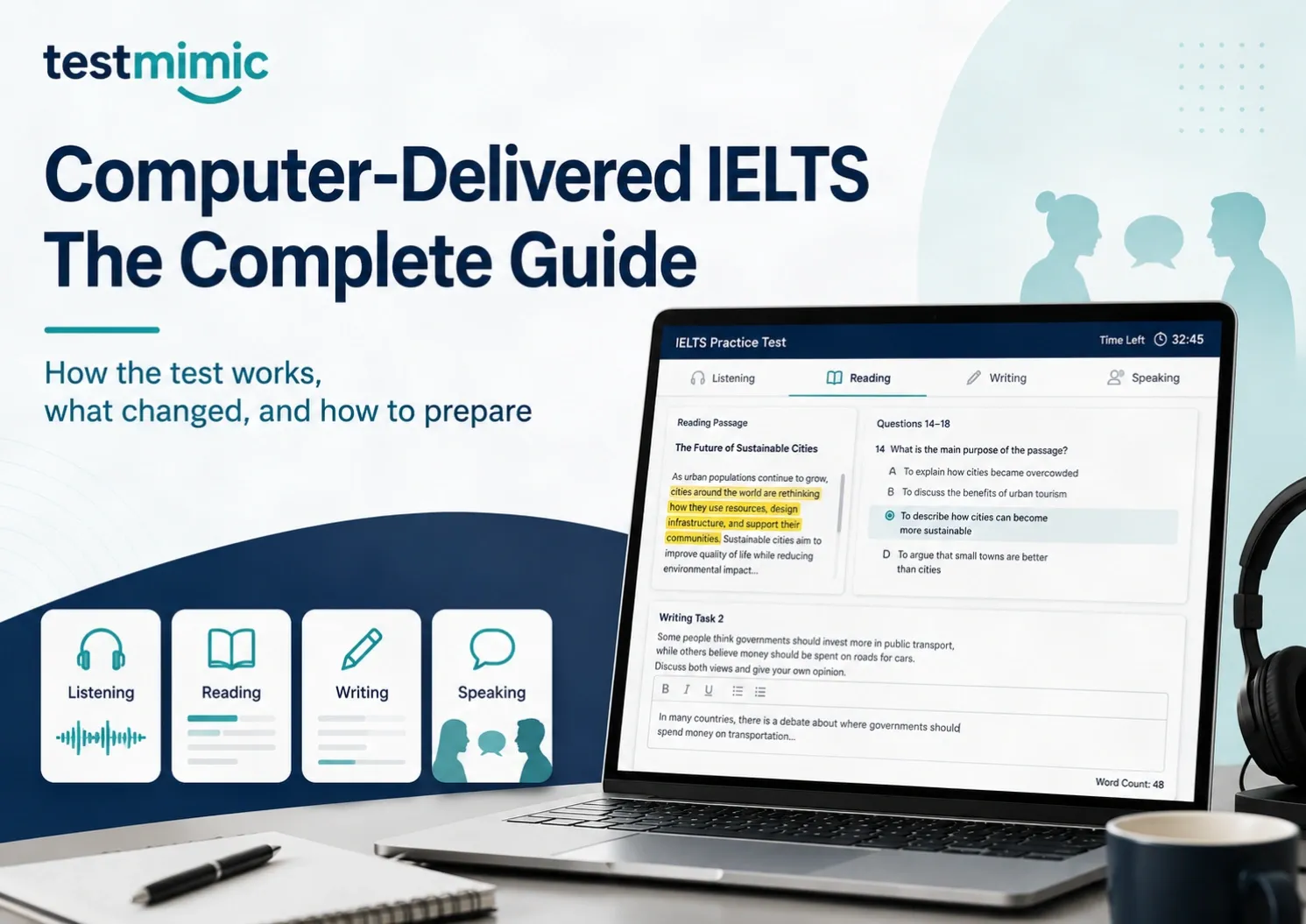
Reading, rebuild your annotation reflexes. Everything you did with a pencil has an on-screen equivalent: highlighting replaces underlining, the notes feature replaces margin scribbles, and clicking question numbers replaces page-flipping. Spend two or three practice passages consciously using each tool until it stops requiring thought. Most paper-trained candidates find their scanning speed dips for the first few sessions and then matches or beats their paper speed, because direct navigation is genuinely faster than flipping.
Writing, exploit the editor. Stop drafting the way handwriting forced you to (linear, cautious, afraid of crossing out). On screen, write your body paragraphs first if the introduction isn't coming, restructure freely, and use the live word count instead of counting lines. Plan on the on-screen notes area or provided paper, whichever your centre allows.
Week 3: Simulate and stabilise
Take two more full mock tests under strict exam conditions, one at the start of the week, one at the end. Full length, no pauses, timer running, no dictionary. Between them, drill whichever section showed the biggest paper-to-computer gap.
By the second mock of this week, the interface should feel invisible: you should be thinking about the questions, not the screen. That is the definition of ready. If a section still feels mechanically awkward, extend the plan by a week rather than booking the real test, a rushed booking costs far more than a delayed one.
Check one logistical point: if you strongly prefer handwriting your essays, ask your local test centre whether the optional "Writing on Paper" mode is offered in your market. It covers the Writing section only, is available in selected locations, and is not offered for UKVI (SELT) tests. Do not build your preparation around it unless your centre confirms availability.
The mindset shift that matters most
Paper-trained candidates often frame the computer format as a threat. The data points the other way: faster results (1???5 days instead of ~13), more available test dates, editing tools in Writing, and no answer-transfer risk in Listening. Once the mechanics are automatic, most candidates find the computer format easier to perform in.
Your months of paper preparation built the knowledge. Three weeks of format conversion lets that knowledge show up in your band score.
Start with the benchmark: take a free computer-delivered mock test on TestMimic today, see exactly where the format gap sits for you, and make the three weeks count.
Frequently asked questions
Is my paper-based preparation wasted now? No. All content knowledge, vocabulary, grammar, strategies, essay structures, transfers fully. Only the physical habits (handwriting, pencil annotation, answer transfer) need converting, which takes most candidates two to four weeks.
How long does it take to switch from paper to computer IELTS preparation? For most candidates, about three weeks of format-specific practice: one week of typing and interface basics, one week converting section routines, one week of full simulations.
Will my band score drop on the computer format? Your first computer mock often scores slightly below your paper practice level, that gap is format friction, not lost ability, and it closes quickly with on-screen practice. Candidates who walk into the real test without any screen practice are the ones who genuinely lose marks.
What typing speed do I need for IELTS Writing? Around 25???30 words per minute with good accuracy is a comfortable working level for producing 250+ words in Task 2 with time to plan and review.
Can I still handwrite anything in the test? In selected markets, the optional "Writing on Paper" mode allows handwritten answers for the Writing section only, Listening and Reading remain on computer. It is not available for UKVI tests. Confirm availability with your test centre before relying on it.
What is the biggest single difference I should prepare for? Listening. The ten-minute answer-transfer period from the paper test no longer existsm, you type answers as you listen. Practising that combined skill on a real interface is essential.