The Complete Guide to Computer-Delivered IELTS (2026)
Computer-delivered IELTS is no longer one of two options, since mid-2026, it is the IELTS. With paper-based testing discontinued in most of the world after 27 June 2026, every candidate now sits Listening, Reading, and Writing on a computer at an official test centre, with Speaking remaining a face-to-face interview.
This guide is the complete reference: what the test looks like, how each section works on screen, how scoring and results operate, and how to prepare for a format that rewards specific practice. Use it as your starting point, and follow the linked deep-dive guides where you need more detail.
What computer-delivered IELTS is
Computer-delivered IELTS (often shortened to CD-IELTS) is the same IELTS test, identical question types, identical Academic and General Training versions, identical 1-9 band scale and assessment criteria, delivered through a computer at a test centre rather than on paper. You still travel to an official centre; this is not an at-home online test. Test-centre conditions, invigilation, and identity checks all continue as before.
Three things define the experience:
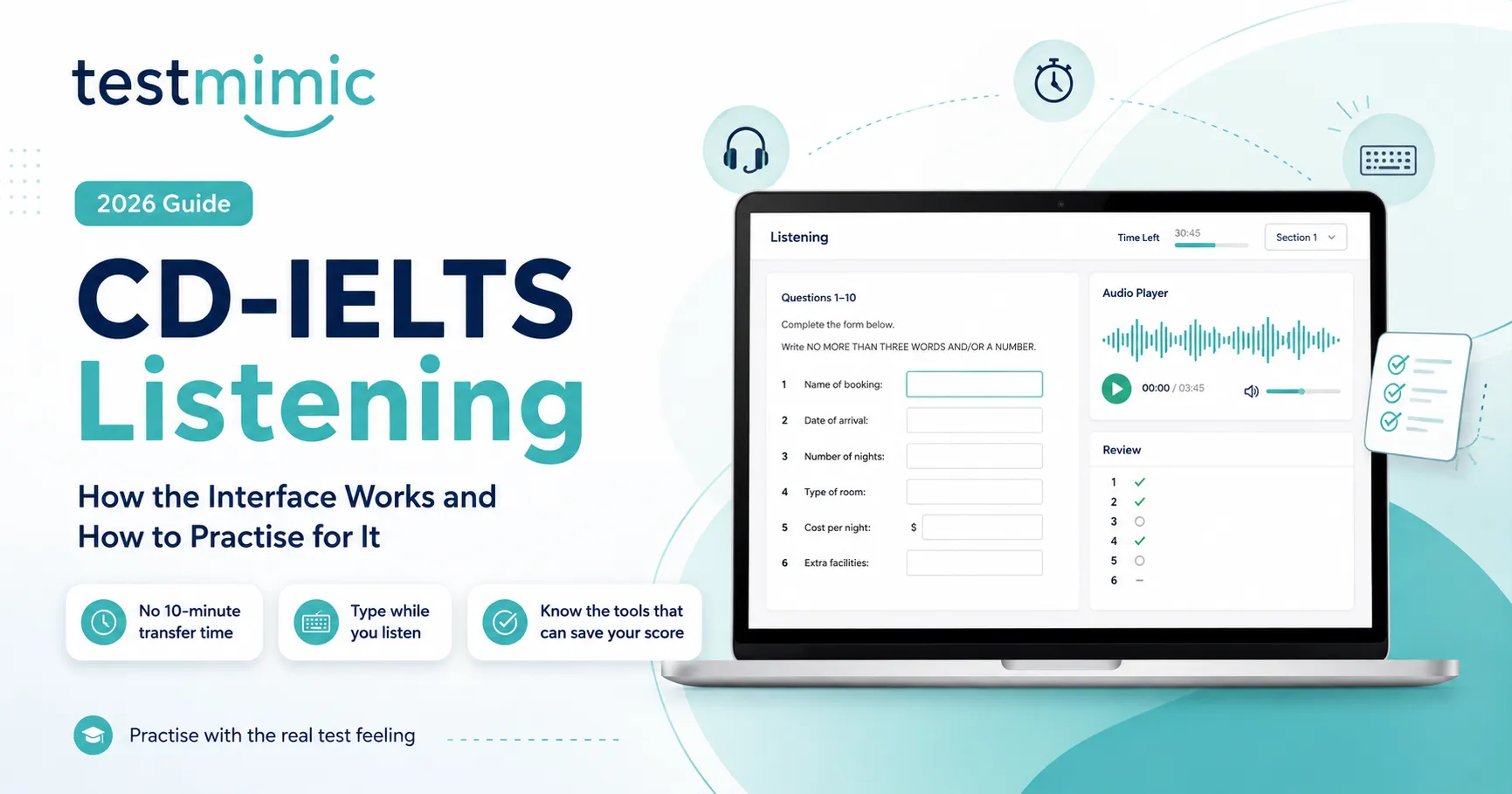
Everything except Speaking happens on screen. You read passages, hear audio through headphones, and type all answers.
Speaking is unchanged. A live, face-to-face interview with a trained examiner, 11–14 minutes, three parts.
Results arrive in 1–5 days, one of the format's biggest practical advantages over the old ~13-day paper timeline.
The test structure at a glance
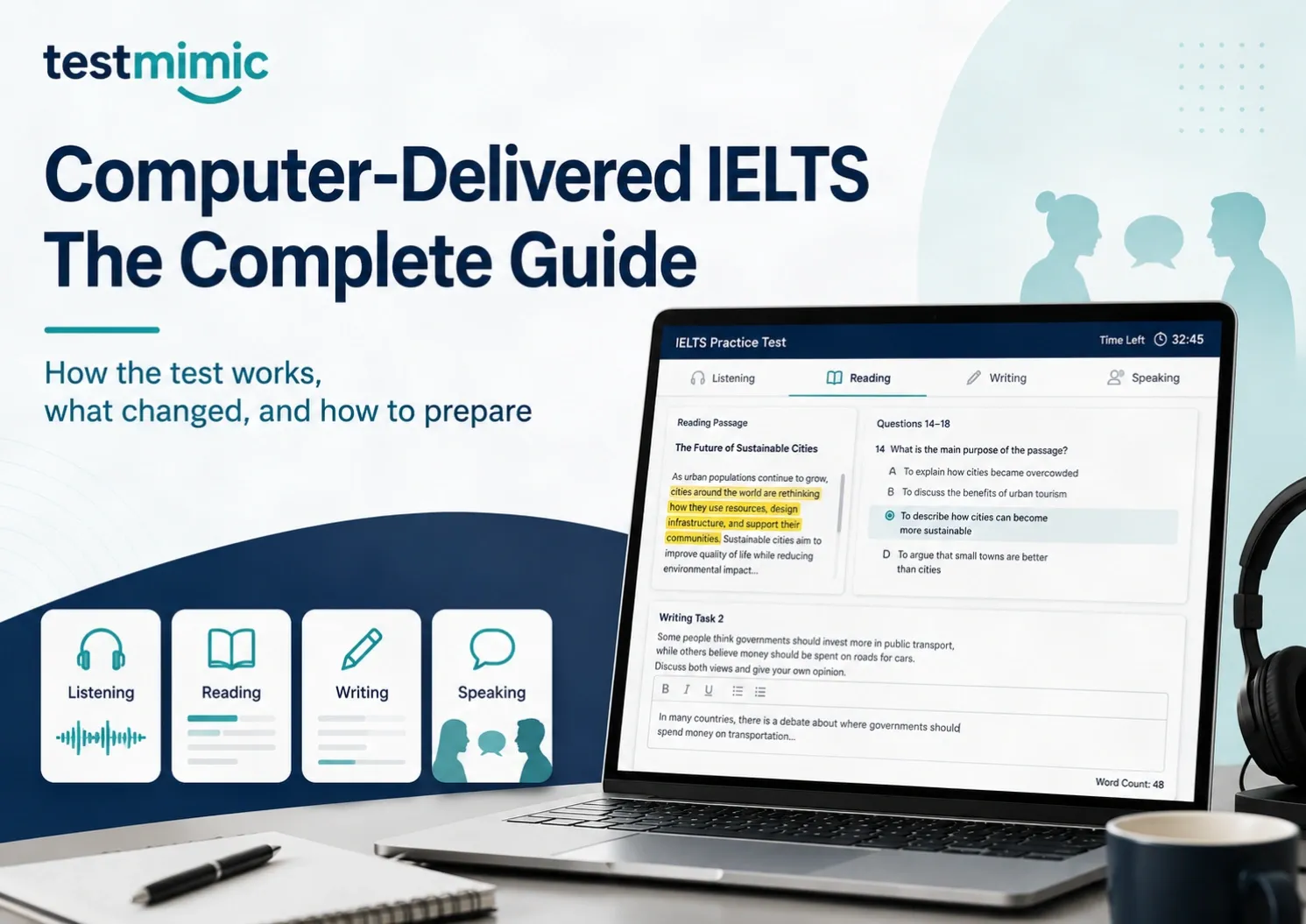
Section | Duration | Format on computer |
Listening | ~30 minutes + short check time | Audio through headphones; type answers directly on screen; no 10-minute transfer period |
Reading | 60 minutes | Passages on screen with highlighter and notes tools; click navigation between questions |
Writing | 60 minutes | Two tasks, typed, with live word count and full editing (cut/copy/paste) |
Speaking | 11–14 minutes | Face-to-face with an examiner, not on computer |
Academic and General Training both continue, differing (as always) in the Reading passages and Writing Task 1.
Section by section: how the screen changes the game
Listening
The audio plays once, through individual headphones, a genuine upgrade over paper-era room speakers. You type answers into on-screen fields as you listen.
The critical difference from the paper era: there is no answer-transfer period. Paper candidates got ten minutes at the end to copy answers to a sheet; computer candidates get only a brief review window. Spelling must be right in real time. This is the single change most likely to cost an unprepared candidate marks, and it is entirely trainable.
Reading
Passages appear on one side of the screen, questions on the other, no page-flipping. You can highlight text, attach notes to selections, and jump directly to any question via a navigation bar. A review screen shows which questions are answered, flagged, or blank.
Former paper candidates usually find on-screen skimming slightly slower for the first few sessions, then equal or faster once the tools become automatic. The candidates who lose time are the ones discovering the highlighter during the real test.
Writing
You type both tasks in a plain text editor with a live word count. No spell-checker, no grammar suggestions, no autocorrectm, your language is assessed exactly as you produce it.
Typing turns out to be the hidden variable of the modern IELTS. The scoring criteria never mention it, but your words-per-minute determines how much of the 60 minutes goes to thinking versus transcribing. Below roughly 25 wpm, Task 2 becomes a race; at 30+ wpm, the editor becomes an advantage paper never offered, restructuring paragraphs, inserting sentences, fixing errors in seconds.
In selected markets, an optional Writing on Paper mode lets you handwrite this one section while taking the rest on computer. It is location-dependent, still rolling out, and not available for UKVI (SELT) tests, confirm with your centre rather than assuming.
Speaking
Unchanged in every respect. Same format, same criteria, same human examiner. Your Speaking preparation carries over from any era of IELTS prep untouched.
Scoring, results, and retakes
Scoring is identical to the paper era: band 1–9 in half-band steps, same descriptors, same examiner standards for Writing and Speaking. Typed essays are held to exactly the same standard as handwritten ones were.
Results typically arrive in 1–5 days, transforming timeline planning for university and visa deadlines.
One Skill Retake lets you redo a single section rather than the entire test, in the same delivery mode as your original attempt.
Test dates run multiple times per week at most centres, so booking flexibility is dramatically better than the old paper calendar.
Is the computer format easier or harder?
The honest answer: the content is equally difficult, and the experience favours whoever practised in it. The computer format removes some risks (lost answer sheets, illegible handwriting, transfer errors) and adds others (typing dependency, screen-reading fatigue, real-time spelling in Listening).
What the question misses is that "easier or harder" is no longer a choice you make, it is a format you prepare for. The score gap in 2026 is not between paper people and computer people; it is between candidates who met the interface before test day and candidates who met it during.
How to prepare for computer-delivered IELTS
Move all practice on screen. Printed practice books still contain valid questions, but working them on paper rehearses obsolete mechanics.
Fix typing first if it is a bottleneck. It is the foundation every Writing session builds on.
Learn the interface tools deliberately, highlighter, notes, navigation, review screen, until they need no thought.
Take full-length mock tests in the real format. Nothing else replicates the combined pressure of the timer, the tools, and the transfer-free Listening flow. Simulating true exam conditions is a skill of its own: How to Simulate Real IELTS Exam Conditions at Home.
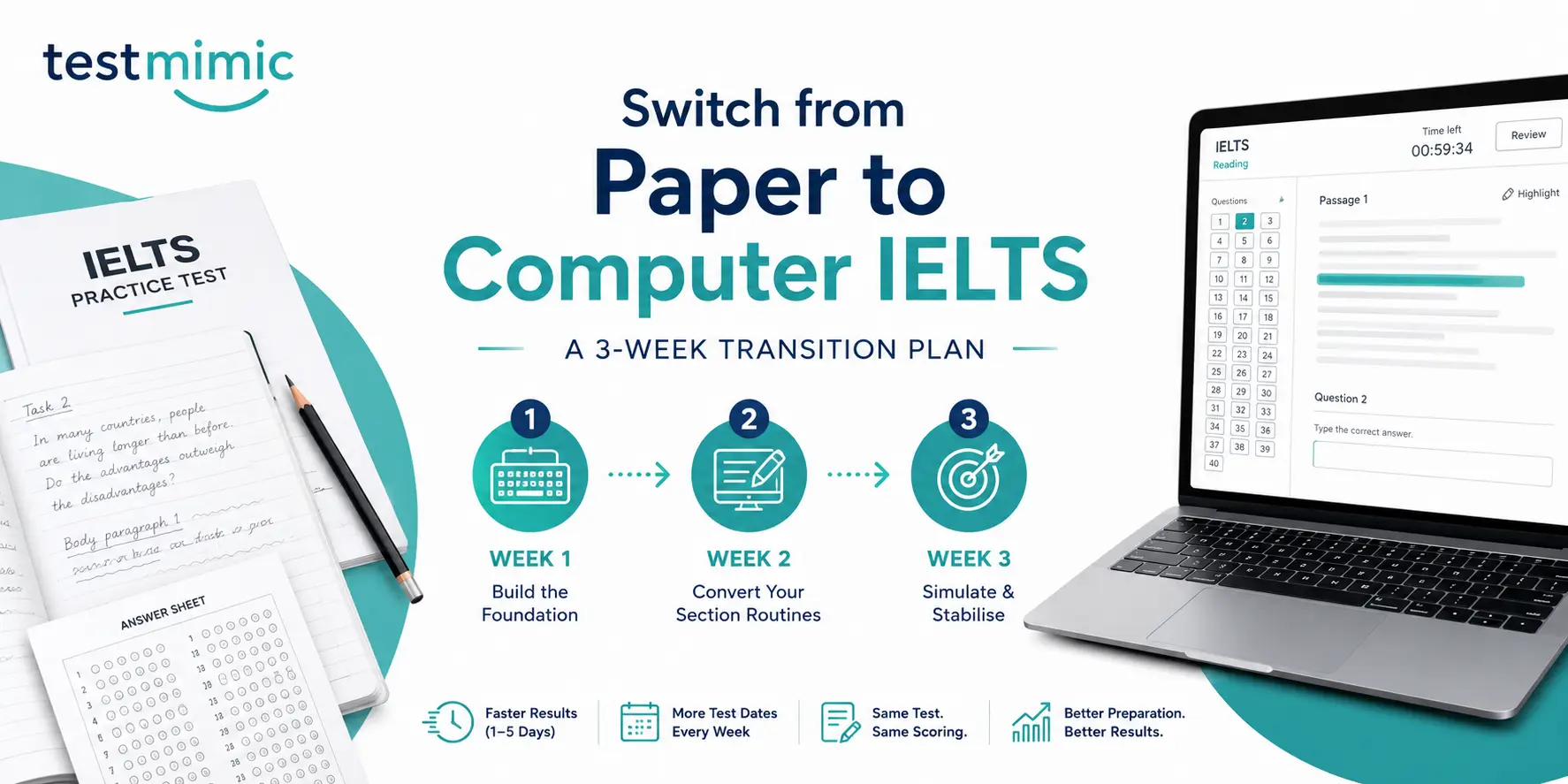
If you trained on paper, run the structured conversion: the three-week paper-to-computer transition plan.
TestMimic exists for exactly step 4: full-length, computer-delivered IELTS mock tests that replicate the real interface, the timer, the highlighter, the typed Writing environment, the no-transfer Listening, with real feedback on your performance and where to improve. Take a free mock test and make the format a solved problem before it meets your band score.
Country-specific information
Test fees, centre availability, and rollout details (including the Writing on Paper option) vary by market. See our country guides for local specifics:
IELTS in Bangladesh 2026
IELTS in India 2026
IELTS in Nepal 2026
IELTS in Pakistan 2026
Frequently asked questions
Is computer-delivered IELTS taken at home? No. You take it at an official test centre under invigilated conditions. Only the delivery medium is digital; the security and setting are unchanged.
Are the questions different from the old paper test? No. Question types, sections, difficulty, and the Academic/General split are identical. Only the medium changed.
Is Speaking on the computer too? No. Speaking remains a live, face-to-face interview with a human examiner in all markets.
How fast are results? Typically 1–5 days, compared with about 13 days in the paper era.
Can I use a spell-checker in Writing? No. The Writing editor has a live word count and standard editing functions, but no spelling or grammar assistance. Your language is assessed as you type it.
What typing speed do I need? Around 25–30 words per minute with good accuracy is a comfortable baseline for completing both Writing tasks with planning and review time.
Is there any way to handwrite my answers now? Only via the optional Writing on Paper mode, in selected markets, for the Writing section only, and not for UKVI tests. Check availability with your local centre.